

Table of Contents
What Are Dental Implants?
How Do Dental Implants Work?
Who May Be Suitable for Dental Implants?
Benefits of Dental Implants
Dental Implant Procedure: Step-by-Step
How Long Does Dental Implant Treatment Take?
Dental Implant Recovery and Aftercare
How Much Do Dental Implants Cost in Cuttack?
Factors That Affect Dental Implant Cost
Dental Implants vs Dentures
Dental Implants vs Dental Bridges
Are Dental Implants Painful?
Possible Risks and Complications
How Long Do Dental Implants Last?
How to Prepare for Dental Implant Treatment
How to Choose a Dental Implant Clinic in Cuttack
Frequently Asked Questions
Conclusion
What Are Dental Implants?
Missing teeth can affect more than just your smile. They can make eating difficult, affect the way you speak, and even change the shape of your face over time. If you have been searching for a dental clinic in Cuttack that offers a reliable solution for missing teeth, dental implants are one option worth understanding.
A dental implant is an artificial tooth root, typically made of titanium, that is surgically placed into the jawbone. Once the implant integrates with the bone, a small connector called an abutment is attached, and a custom-made dental crown is placed on top. The result is a tooth replacement that looks, feels, and functions much like a natural tooth.
Unlike dentures or bridges, dental implants replace both the visible part of the tooth and the root. This helps preserve the jawbone and maintain the structure of your face. For residents of Cuttack and nearby areas, dental implant treatment is becoming increasingly accessible as more dental clinics offer this advanced procedure.
How Do Dental Implants Work?
The success of a dental implant depends on a biological process called osseointegration. This is the process where the jawbone grows around the implant and holds it firmly in place.
Here is how it works in simple terms:
- The titanium implant is placed into the jawbone during a surgical procedure.
- Over the next few months, the bone cells attach themselves to the implant surface.
- This fusion creates a stable, secure foundation for the artificial tooth.
Because titanium is biologically compatible with the human body, the risk of rejection is very low. The implant becomes a permanent part of your jaw, providing the same kind of support that a natural tooth root would.
Osseointegration is what makes dental implants different from other tooth replacement options. It is also why implants can last for many years with proper care.
Who May Be Suitable for Dental Implants?
Not everyone is automatically suitable for dental implants. Candidacy depends on several factors, and only a dentist can determine suitability after a thorough examination.
You may be a candidate if you:
- Have one or more missing teeth
- Have healthy gums with no active gum disease
- Have enough bone in your jaw to support the implant
- Have a jawbone that has reached full growth
- Do not have health conditions that affect bone healing
- Are willing to commit to the treatment timeline
- Do not smoke or are willing to quit
Some factors that may affect suitability include:
- Active gum disease or untreated tooth decay
- Significant bone loss in the jaw
- Uncontrolled diabetes or other conditions affecting healing
- Smoking or tobacco use
- Certain medications that affect bone metabolism
If you do not have enough bone, a bone graft may be an option. If you have active gum disease, it will need to be treated first.
A professional evaluation at a dental clinic in Cuttack will help determine whether dental implants are right for you.
Benefits of Dental Implants
Dental implants offer several potential advantages for people with missing teeth. According to the American Dental Association (ADA), implants provide firm support for artificial teeth and help prevent the jawbone from shrinking.
Key benefits include:
- Improved chewing ability – Implants allow you to chew comfortably and efficiently, similar to natural teeth
- Natural appearance – The crown is custom-made to match your existing teeth
- Speech improvement – Unlike ill-fitting dentures, implants do not slip or move when you speak
- Bone preservation – Implants stimulate the jawbone, helping prevent bone loss that occurs when teeth are missing
- No dependence on adjacent teeth – Unlike bridges, implants do not require support from neighbouring teeth
- Long-lasting – With proper care, implants can last many years
- Comfort and stability – Implants are anchored securely, so they do not shift or cause discomfort
Dental implants can replace a single tooth, multiple teeth, or support full dentures. They are a versatile option for many people with missing teeth.
Dental Implant Procedure: Step-by-Step
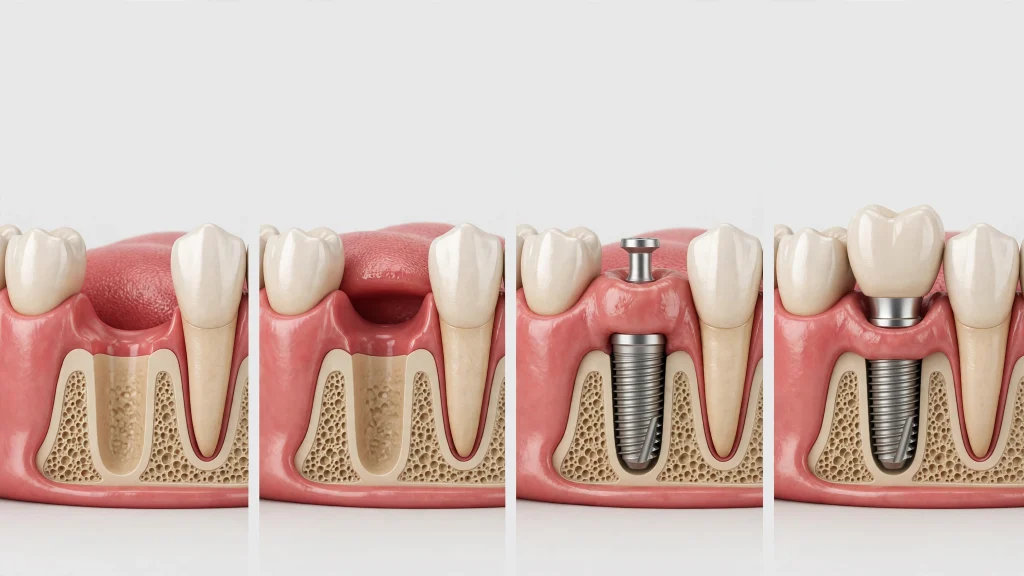
Understanding the dental implant procedure can help you feel more prepared. The process typically involves several stages over a few months.
1. Dental Examination and Consultation
Your dentist will examine your teeth, gums, and jawbone. X-rays or CT scans may be taken to assess bone density and plan the implant placement.
2. Imaging and Treatment Planning
Detailed images help your dentist determine the exact position for the implant. This planning stage is crucial for a successful outcome.
3. Tooth Extraction if Required
If the missing tooth is still present, it will need to be removed before the implant can be placed.
4. Bone Grafting if Required
If you do not have enough bone, a bone graft may be performed to build up the jawbone. This can extend the treatment timeline.
5. Implant Placement
The dentist makes a small incision in the gum and places the titanium implant into the jawbone. Local anaesthesia is used to keep you comfortable.
6. Healing and Osseointegration
The implant is left to heal and integrate with the bone. This process typically takes 3 to 6 months.
7. Abutment Placement
Once healing is complete, a small connector called an abutment is attached to the implant. This will hold the crown.
8. Crown Placement
A custom-made crown is created to match your natural teeth and is securely attached to the abutment.
9. Follow-Up
Regular check-ups are important to monitor the implant and surrounding tissues.
How Long Does Dental Implant Treatment Take?
The total treatment time for dental implants varies from person to person. It depends on factors such as:
- Whether you need a tooth extraction
- Whether bone grafting is required
- How quickly your bone heals
- The number of implants being placed
In general, the process can take anywhere from a few months to over six months. The healing phase (osseointegration) alone takes about 3 to 6 months. Some cases may be completed in a shorter time, while others may require longer.
It is important to discuss the expected timeline with your dentist during the consultation.
Dental Implant Recovery and Aftercare
Recovery after dental implant surgery is usually manageable. Here are some general aftercare guidelines:
- Follow your dentist’s instructions – This is the most important step.
- Maintain oral hygiene – Gently brush and floss around the implant area as advised.
- Eat soft foods – Stick to soft foods for the first few days after surgery.
- Avoid smoking and tobacco – Smoking can interfere with healing.
- Attend follow-up appointments – Regular check-ups help monitor healing.
- Watch for unusual symptoms – Contact your dentist if you experience severe pain, swelling, bleeding, or signs of infection.
Most people can resume normal activities within a day or two, but it is important to avoid strenuous exercise for a few days.
How Much Do Dental Implants Cost in Cuttack?
The dental implant cost in Cuttack varies depending on several factors. It is important to understand that prices can differ significantly between clinics and patients.
Across India, the cost of a single dental implant typically ranges from ₹25,000 to ₹60,000. Some sources report ranges from ₹16,000 to ₹80,000 or more. Full-mouth restorations can cost anywhere from ₹2.5 lakh to ₹8 lakh, depending on the number of implants and the type of prosthesis used.
[COST INFORMATION TO BE VERIFIED WITH PEARL AESTHETICS]
When asking about cost, it is important to clarify what is included. Ask whether the quoted price covers:
- Consultation and examination
- Diagnostic imaging (X-rays/CT scan)
- The implant fixture
- The abutment
- The crown
- The surgical procedure
- Follow-up appointments
Different clinics may structure their pricing differently, so always request a detailed breakdown during your consultation.
Factors That Affect Dental Implant Cost
Several factors influence the overall cost of dental implant treatment:
| Factor | Why It Can Affect Cost |
|---|---|
| Number of implants | More implants may increase overall treatment cost |
| Implant system | Different implant systems have different costs |
| Crown material | Crown type and material affect pricing |
| Bone grafting | Additional procedures may be required |
| Tooth extraction | Extraction may add to treatment cost |
| Diagnostic imaging | Imaging may be required for planning |
| Case complexity | Complex cases may require additional treatment |
| Follow-up care | Post-treatment monitoring may affect overall cost |
It is always a good idea to ask for a written treatment plan with a clear cost breakdown before starting treatment.
Dental Implants vs Dentures
Dentures and dental implants are both options for replacing missing teeth, but they work very differently.
The right choice depends on your dental condition, goals, and budget.
Dental Implants vs Dental Bridges
Bridges and implants are both used to replace missing teeth, but they differ in how they are supported.
Neither option is universally better. The best choice depends on your specific situation and dental health.
Are Dental Implants Painful?
Many people worry about pain during dental implant surgery. The procedure is performed under local anaesthesia, so you should not feel pain during the placement.
After the surgery, you may experience some soreness, swelling, or mild discomfort. This is normal and usually manageable with over-the-counter or prescribed pain medication.
Individual experiences vary. Some people report minimal discomfort, while others may feel more sensitivity. Your dentist will provide instructions on how to manage any post-operative discomfort.
It is important to follow your dentist’s aftercare advice to support a smooth recovery.
Possible Risks and Complications
Like any surgical procedure, dental implant surgery carries some risks. According to the Mayo Clinic, these risks are generally small and usually minor and easily treated when they occur.
Potential risks include:
- Infection at the implant site
- Injury or damage to surrounding structures, such as other teeth or blood vessels
- Nerve damage, which can cause pain, numbness, or tingling in the gums, lips, or chin
- Sinus problems, if implants in the upper jaw extend into sinus cavities
- Implant failure – although rare, implants can fail in some cases
- Peri-implantitis – inflammation around the implant
Proper evaluation, careful planning, good oral hygiene, and regular follow-up can help reduce these risks.
How Long Do Dental Implants Last?
Dental implants are designed to be long-lasting. With proper care, the implant fixture itself can last many years, and in some cases, a lifetime.
However, the crown (the visible part of the tooth) may need replacement or maintenance over time due to normal wear and tear. The longevity of your implant depends on several factors:
- Your oral hygiene habits
- Your gum health
- Whether you smoke or use tobacco
- Your bite forces
- Regular dental check-ups
- How well you follow aftercare instructions
While implants are durable, they require the same care as natural teeth – regular brushing, flossing, and dental visits.
How to Prepare for Dental Implant Treatment
Preparing for dental implant treatment can help ensure a smoother experience. Here is a practical checklist:
- Complete a dental examination – Your dentist will assess your oral health.
- Discuss your medical history – Tell your dentist about any medical conditions or medications.
- Complete recommended imaging – X-rays or CT scans help with treatment planning.
- Stop or reduce tobacco use – Smoking can affect healing.
- Follow pre-treatment instructions – Your dentist may give specific advice.
- Arrange post-treatment care – Plan for someone to drive you home if needed.
- Ask about total treatment cost – Get a clear breakdown of what is included.
- Ask what is included in the package – Clarify whether consultation, imaging, surgery, and follow-up are covered.
Being well-prepared can help you feel more confident about the process.
How to Choose a Dental Implant Clinic in Cuttack
Choosing the right dental clinic is an important decision. Here are some factors to consider when looking for a dental clinic in Cuttack:
- Dentist’s qualifications and experience – Look for training and experience in implant dentistry.
- Diagnostic facilities – Does the clinic have digital X-rays or CT scanning?
- Sterilisation and infection-control practices – Cleanliness and hygiene are essential.
- Treatment planning – Does the dentist provide a clear, individualised treatment plan?
- Implant system transparency – Ask which implant system is used and why.
- Clear cost explanation – Request a written estimate with a breakdown of costs.
- Follow-up care – Ask about post-treatment monitoring and support.
- Patient reviews – While helpful, reviews should not replace professional evaluation.
Frequently Asked Questions About Dental Implants
1. What is a dental implant?
A dental implant is a titanium post that is surgically placed into the jawbone to replace the root of a missing tooth. A crown is then attached to complete the tooth replacement.
2. How much do dental implants cost in Cuttack?
The cost varies depending on the number of implants, the implant system, the crown material, and whether additional procedures like bone grafting are needed. In India, single implants generally range from ₹25,000 to ₹60,000. Always get a personalised quote.
3. Are dental implants painful?
The procedure is performed under local anaesthesia, so you should not feel pain during surgery. Some soreness or swelling afterward is normal and manageable.
4. How long does dental implant treatment take?
Treatment can take several months, including a healing period of 3 to 6 months for osseointegration. The total timeline depends on your individual case.
5. Who is eligible for dental implants?
Candidates typically need healthy gums, enough bone to support the implant, and good overall health. A dental evaluation is required to determine suitability.
6. How long do dental implants last?
With proper care, the implant fixture can last many years, and the crown may need replacement over time.
7. Can one missing tooth be replaced with an implant?
Yes, a single tooth implant is a common and effective way to replace one missing tooth.
8. Are dental implants better than dentures?
Neither is universally better. Implants offer greater stability and bone preservation, while dentures are non-surgical and have a lower upfront cost. The right choice depends on your needs.
9. Can smokers get dental implants?
Smoking can affect healing and increase the risk of implant failure. Dentists may recommend quitting or reducing smoking before treatment.
10. What happens if there is not enough jawbone?
If you do not have enough bone, a bone graft may be performed to build up the jawbone before implant placement.
11. Do dental implants look natural?
Yes, the crown is custom-made to match the colour, shape, and size of your natural teeth.
12. How should I care for dental implants?
Care for implants just like natural teeth – brush twice daily, floss, and visit your dentist regularly for check-ups.
Conclusion
Dental implants are a well-established option for replacing missing teeth. They can help restore your ability to chew comfortably, speak clearly, and smile with confidence. Unlike dentures or bridges, implants replace the tooth root and help preserve the jawbone, which can support your facial structure over time.
However, implants are not suitable for everyone. Candidacy depends on your oral health, bone availability, gum condition, general health, and lifestyle factors such as smoking. A thorough evaluation by a qualified dental professional is essential before making any decisions.
If you are considering dental implants, take the time to research your options, ask questions, and choose a clinic that prioritises patient safety, clear communication, and evidence-based care. For residents of Cuttack and nearby areas, consulting a trusted dental clinic in Cuttack can help you understand whether dental implants are the right choice for you.
Remember, the best treatment is one that is tailored to your individual needs and goals. Schedule a consultation to discuss your situation with a dental professional who can guide you through the process.
Address :-
C446, Eye Hospital Road, above Urban Cooperative Bank, CDA Sector VI, Cuttack
Contact :- +91 88954 34284
Book an appointment
Disclaimer: This article is for informational purposes only and does not constitute medical advice. Dental implant suitability depends on individual factors. Always consult a qualified dental professional for personalised guidance regarding your specific condition and treatment options.